

Rangeland Restoration Themes from SageCon Summit 2025
A synthesis on rangeland restoration
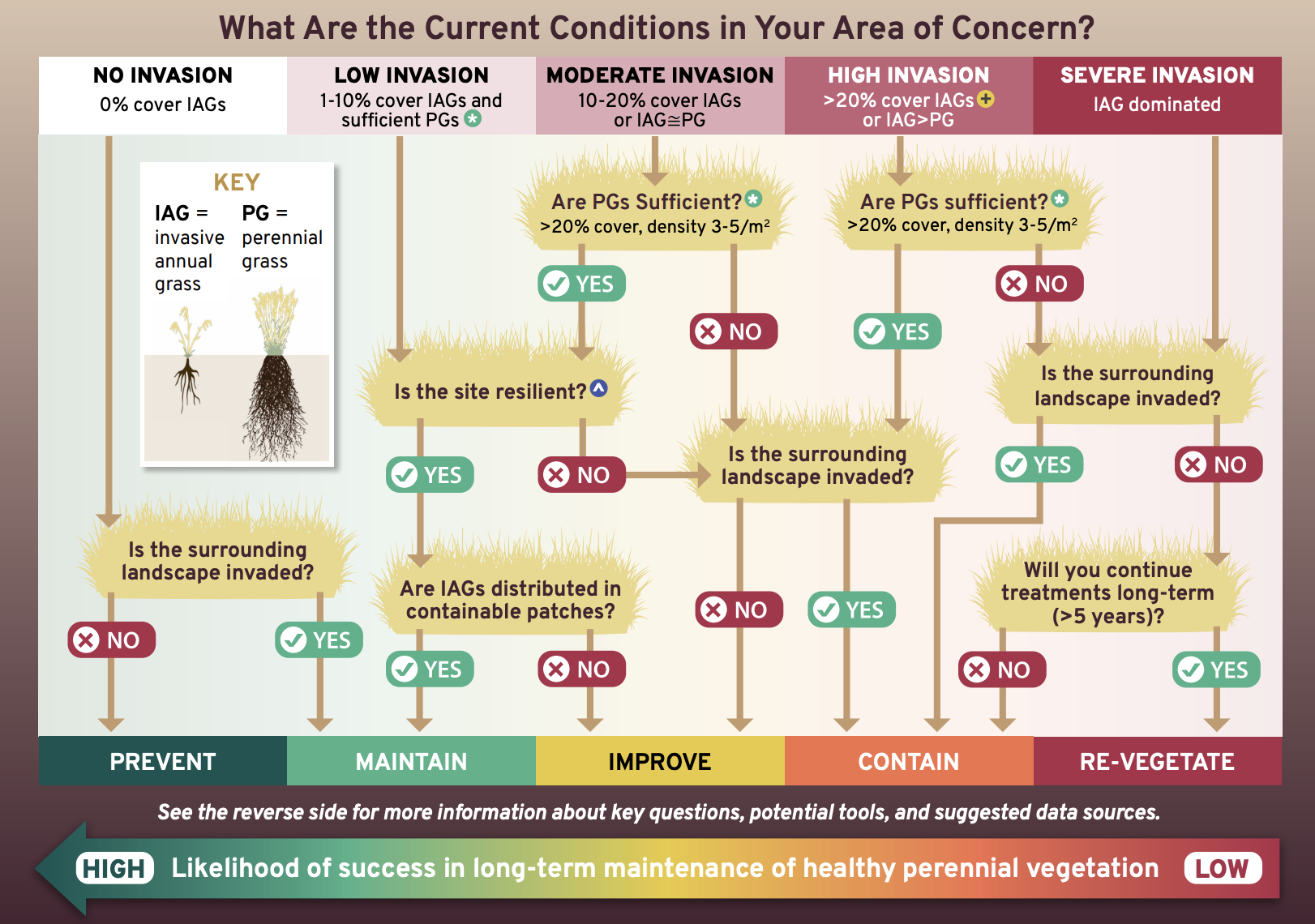
This Invasive Annual Grass Decision Tree was developed to help managers make decisions in the field. Print a copy and take it on your next field day.
At the SageCon Partnership Annual Summit in October 2025, a rangeland restoration panel delivered practical information on restoration and post-fire rehabilitation, with a focus on strategic management of invasive annual grasses (IAGs). The presentation recording and slides are available online and this synthesis draws out key information from the panel and organizes it by theme.
Click each section below to find out more information.
-
Managing invasive annual grasses is a long game – although there are no silver bullets (sorry!), there are numerous tools and a large body of science and information to empower rangeland managers as they develop long-term programs for IAG management.
-
The mantras of “an ounce of prevention is worth a pound of cure” and “defend and grow the core” both point to the importance of taking decisive, proactive action to prevent further degradation of our most intact remaining rangelands.
-
We have an increasing number of maps, tools, and spatial datasets that can help us look across large landscapes and develop treatment priorities. With IAGs, spatial context really matters, as these invaders are spreading across boundaries with and without fire.
-
Judicious use of herbicides can promote perennial grasses when carefully choosing among chemicals and considering the broader plant community.
-
A new decision tree walks practitioners through a set of key questions to guide an approach and potential IAG treatment options across the spectrum of conditions from prevention to strategic restoration to containment or revegetation.
-
In an ecosystem increasingly affected by wildfires, we can draw from a large body of research on post-fire impacts and treatment effects.
-
The SageCon Partnership and our partner networks provide a wealth of information and resources.
Take the Long View
Success will be easier to achieve with the right mindset – playing the long game, incorporating landscape context, thinking through risks and rewards of treatment options, and embracing experimentation and learning. Sagebrush country is characterized by relatively harsh conditions, with cold winters, very dry summers, and high variability in weather conditions within and across years. With this entrenched variability, threats like IAGs have no “silver bullet” or “one-and-done” answer, and managing IAGs is an evolving and long-term endeavor. However, tools and technology have advanced rapidly, improving our ability to steward these landscapes and combat IAGs, and many rangeland experts are optimistic that we can hold the line and maintain resource values in at least some landscapes.
Act Proactively
Invasive annual grasses are arguably the biggest threat to sagebrush rangelands in the West and are the focus of many management actions. Our best chance for restoration success is being actively proactive: monitoring/early detection and treatment, managed grazing to avoid additive stress on perennial grasses, reducing excess fuels, proactive vegetation management, fuel breaks, etc. These activities could use more funding and attention. When it comes to managing invasive species, we know that proactive management – taking action before a problem is entrenched or even obvious to the casual observer – is more efficient, more effective, and lower-cost. We all know the old adage “an ounce of prevention is worth a pound of cure,” - but according to Mark Porter at the Oregon Department of Agriculture, prevention is even better than a pound of cure. True prevention keeps invaders out, and early detection, rapid response (EDRR) involves aggressive monitoring and spot treating of infestations. Mark describes EDRR as “we find it before it gets big, before it develops a large seed bank spread over a wide area, and we treat it… if we aren’t doing that intentionally and actively, we will fail.”
The tools for prevention aren’t glamorous, but wash stations, boot brushes, hay exchange, and weed-free certifications are all a part of the solution to reduce sources of IAG seeds on ATVs, boots, hay, seed, animals, roads and other vectors. For example, treating roadsides like the one in the photo below before IAGs spread into adjacent intact landscapes is much more effective than broad-scale restoration once IAGs have spread widely. In the words of Anya Tyson of The Nature Conservancy, “I call this the ‘ounce of prevention is worth a pound of cure’ vs the ‘if it ain’t broke don’t fix it’ standoff of folk wisdom. By the time you have a bunch of folks concerned about it, like your average community members that aren’t kicking dirt as much as ranchers and range management specialists and wildlife biologists are, you have a lot less options.”
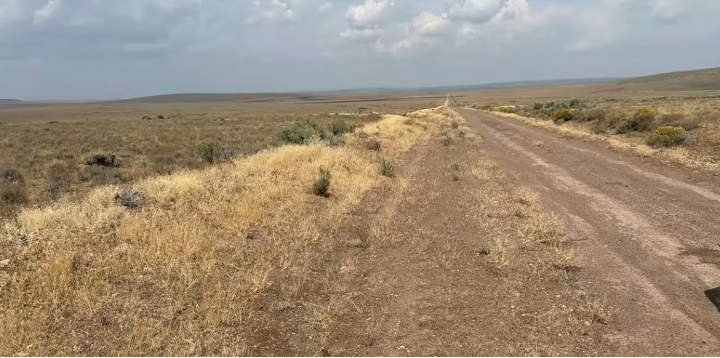
Above is a photograph of a road shoulder invaded by annual grasses. Roads like this can form an extensive network of vectors to introduce invaders into intact plant communities.
Currently, most investments in restoration on public lands are made in post-fire rehabilitation treatments as opposed to more proactive, early intervention. Post-fire restoration provides an important opportunity for immediate site stabilization and rehabilitation through restoration actions to facilitate recovery long-term. However, it is also important to make sure proactive management is not forgotten. As Anya says about public land restoration, “sometimes I do see a lot of our NEPA energy that allows us to put management actions on the ground channeled towards post-fire environments”. Anya suggests that we could use years without large fires to rally support for investments in proactive management, focusing on actions to protect our remaining large tracts of healthy rangelands. Plus, from ten years of work on the Soda Fire, we know that vegetation conditions before a fire – including the degree of annual grass invasion - are strongly predictive of post-fire condition, highlighting the importance of managing our vegetation communities for resilience.
Think spatially
Sagebrush country is vast and we cannot pour resources into every acre – so we need to be smart about targeting our efforts. Threat-Based Strategic Conservation (TBSC) provides a framework for local groups to think through a spatial strategy to ‘defend and grow the core’ at localized scales, empowering managers and practitioners to conduct proactive, strategic landscape management within their area of influence. Combining geospatial data showing a snapshot of current or pre-fire vegetation conditions (in this case using threat-based ecostate maps) and abiotic conditions (in this case, an elevation-heatload index) can be a simple but powerful combination - and both these datasets are available for eastern Oregon in the SageCon Landscape Planning Tool. Cameron Duquette of The Nature Conservancy walked us through a process developed by the Eastern Oregon Agricultural Research Center to develop a post-fire TBSC spatial strategy to guide fire rehabilitation actions by combining these two datasets with burn severity. See also a new tool showing an Invasion Severity Index across western rangelands to help target invasive grass management at landscape scales.
Understand the pros and cons of different herbicides
Toby Maxwell of Oregon State University walked us through some guidance on how to weigh tradeoffs and avoid unintended consequences of herbicide treatments. Pre-emergent herbicide is the most common IAG control method for reducing annual cover and releasing desirable perennials, which can increase community resilience to drought and improve wildfire recovery. However, other tools, including managed grazing, seeding, and other types of herbicides, can be part of a suite for IAG management.
Know the pros and cons of the different herbicides. The big names in preemergent herbicides include indaziflam and imazapic - see more information below and on the IMAGINE resources webpage and ensure you get professional guidance.
Indaziflam (Rejuvra) is a pre-emergent herbicide that is often highly effective at controlling annuals for multiple years. The cost of Indaziflam is substantially higher than many other herbicides, but because it targets seed bank reduction or elimination for 3-5 years, the net application cost is often lower. While arguably the most effective tool on the market, there are also concerns to consider before implementing treatments. Indaziflam prevents germination of almost everything for 3-5 years, including native annual forbs and perennial grasses. If your site does not have an existing healthy and robust perennial grass community, treatment can result in large areas of bare soil or a release of invasive perennial forbs (rush skeletonweed, Russian thistle, redstem storksbill, salsify). Indaziflam has relatively “sticky chemistry”, which binds the chemical tightly to the soil. This helps prevent leaching and impacts to deeper-rooted species, but also makes Indaziflam very challenging to apply evenly, as even tiny strips of untreated vegetation will escape the effects of the herbicide. Wind erosion and runoff can move soil at the site of herbicide application and affect surrounding areas, especially after fire.
Imazapic (Plateau) is a pre- and post-emergent herbicide with a lower cost but only a 1-year residence time in soil. Imazipic has a short residence time in soils, allowing for seeding the year after herbicide application. Imazapic can release perennial grasses and lead to long-term resistance to IAGs in some plant communities, and the low price makes it possible to treat larger areas with the same amount of funds. Unlike indaziflam, imazapic is also a post-emergent herbicide that will kill seeds that germinated from fall rains that may still be subsurface, providing earlier results. Key concerns with using imazapic include the potential to damage perennial grasses that are stressed (impacted by drought or overgrazing) or shallow-rooted (Sandberg bluegrass, Idaho fescue). Herbicide resistance can evolve in the target species due to repeated applications. Imazapic has a short duration of activity. Meaning that without follow-up treatment (herbicide, seeding, or other management), restoration can fail.
More powerful together: Indaziflam and imazapic are commonly used together. Here are two general scenarios:
Multi-year Strategy: Year 1: apply imazapic to reduce the seed bank of IAGs, Year 2: seed to establish desirable perennials, Year 3 or 4: (if needed) apply indaziflam for longer-term IAG control.
Mixing: When mixed together in a single treatment, the combination has been shown to reduce IAG coverage more effectively than either chemical alone. Combined treatments must be considered carefully and remember that seeding after indaziflam application will need to wait for multiple years, so ensure your perennial grass community is robust.
Use test plots when you’re not sure: Establishing test plots (i.e., treating a few small areas to gauge the effects of herbicide) can help answer key questions about impacts on sensitive species, recovery potential, the health of perennials, and noxious weeds in the seed bank before implementing a large-scale treatment. These concerns are especially relevant with indaziflam because of the longer residence time in soil. Wait at least two years, especially if you are concerned about the emergence of invasive forbs, to evaluate the results of the test plot treatment.
Use a decision tree to guide management options
A new rangeland health decision tree walks practitioners through key questions for managing rangeland health in light of IAGs, including:
How invaded is your area of concern?
Are perennial grasses sufficient? (general rule of thumb is >20% cover, density at least 3-5/m2 )
Is the site resilient? (i.e., higher elevation, deeper soils, and north aspects)
Is the surrounding landscape invaded?
Are IAGs distributed in containable patches?
Will you be able to continue treatments long-term (>5 years)
In addition to the decision tree, Mark reiterates the essential need for prevention measures, followed by EDRR and properly designed treatments - in that order! As a long-time applicator, Mark reminded us that effective treatments happen only through intentional applications, using the proper tools for the site. Ground applications (backpack and UTV spraying) are best for small areas, vectors, or in challenging, bumpy areas. Drone applications are well-suited to mid-scale treatments (hundreds to several thousand acres). While they are limited in range, drones are effective in steep, rocky, and isolated locations. Helicopters are well-suited for large areas because they fly lower and slower than planes, which are generally less effective. No matter the tool, adjustments to rates, volume, timing, and adjuvants must be fine-tuned to the context and site. Good record keeping, including track logs of exactly what was applied, when, and where. Mark reiterates that Indaziflam (Rejuvra) needs to get into the soil, not onto the plant, and it does not move once it is in the soil, so even very small strips between treated areas can remain as IAG vectors. Applicators need Rejuvra-specific experience or training to understand application principles for uniform coverage.
If you’re unsure of what to do, consult an expert - Mark is a great resource at ODA and you can also talk with your County weed manager, Cooperative Weed Management Area, Soil and Water Conservation District, or OSU extension agent.
Learn from the latest research on post-fire restoration
Matt Germino of the US Geological Survey shared key findings on post-fire recovery and rehabilitation following fires in the Great Basin, focusing on a decade of research on the Soda Fire, which burned in Idaho and Oregon in 2015. This section expands on best practices and specifically focuses on emerging research from recently burned areas, a topic particularly salient in Oregon rangelands after a record-setting fire season in 2024.
Firstly, Matt encourages us to adopt a learning mindset when thinking about post-fire rehabilitation and restoration. All treatments – as well as any decision not to treat an area – should be intentional and approached as an experiment from which we will learn and adapt our future actions. Treatment monitoring and information sharing should contribute to our collective learning.
Embrace variability in the landscape. Although the term “sagebrush sea” implies a homogenous expanse of rangeland as far as the eye can see, we all know that our rangelands are incredibly diverse. Matt encourages us to embrace this heterogeneity, as it affects risk, post-fire recovery, and treatment success. Keep an eye out for the following:
Vegetation composition greatly influences post-fire outcomes, particularly the annual-to-perennial grass ratio and cover percentages of vegetation classes. Healthier areas tend to come through a fire in better shape. If you are uncertain about the condition of an area before the fire, use available pre-fire data and vegetation maps (see Thinking Spatially).
Biophysical variability is important in driving post-fire outcomes, with elevation being the biggest predictor of annual grass invasion – the higher you go, the less likely you will be to have an annual grass problem. A combination of elevation and heatload (included for Oregon in the SageCon Landscape Planning Tool) is useful in describing the relative risk of annual grass invasion.
Microsites are created after a fire – if sagebrush was present before a fire, there will be “fertile islands” where the burned sage creates a conducive environment for the establishment of new plants, both natives and invasives.
Grazing management varies across the landscape – based on state, county, and BLM district lines as well as public vs private land. These variations in management across boundaries and time will impact restoration success.
Immediately after a fire, evaluate soil stability before taking action. According to Matt, “The first thing you should ever consider after a wildfire is: how stable is the soil? If you put herbicides on it, are they going to blow downwind?” Ensure soils are stable before applying herbicide. It may be necessary to wait a few months after a fire for the soil to stabilize before applying any herbicide, especially indaziflam (Rejuvra), which remains active in the soil much longer than many other herbicides. As you may expect, soils in flatter areas without larger rocks are more susceptible to wind movement (see this wind erosion fact sheet). Also, remember that post-fire treatments do not need to occur immediately after the fire - in some cases, waiting a year for treatment may be prudent to evaluate initial recovery and fine-tune management options.
Don’t underestimate Sandberg bluegrass (Poa secunda), a shorter-statured, shallow-rooted perennial bunchgrass that is a native, disturbance-adapted species. It can also be a “freebie” for restoration, as it competes well with IAGs. In fact, in some places, abundant Sandberg bluegrass can be as effective as herbicides or seeding in keeping IAGs at bay. Note that the herbicide imazapic can harm this bunchgrass in some cases, so be cautious and don't dismiss this small but mighty grass.
Post-treatment stewardship matters a lot. Restoration is time-consuming and expensive, and protecting restoration investments is important. Temporary grazing removal following fire and seeding is commonly used to prevent livestock from pulling up new plants before their roots are established. Although crude and far from perfect, the “tug test” – simply pulling on a seedling to see how easily it can become dislodged (using about the force required to lift a full 1L waterbottle) – can be a useful way to determine if seeded grasses have developed deep enough roots to withstand grazing. Some other rules of thumb are: where gaps between perennial plants are greater than about 25”, there are less than 3 plants/m2, and where the basal diameter of grass is less than 3”, be cautious about disturbance (including grazing) in the area.
Conclusion and available resources
Managing invasive annual grasses is a wicked problem that requires the focus of all of our partners if we are going to keep these lands wild and working. The SageCon Partnership annually hosts the SageCon Summit to bring together managers, policymakers, and scientists for conversations focused on addressing complex issues we cannot overcome in isolation. We gather to discuss how we can increase the resilience of Oregon’s rangelands by improving the health of rural communities and ecosystems through actionable ideas. Please join us this Fall for the next Summit. We value the wide range of insight that our partners bring.
For more information, see:
The University of Wyoming’s Institute for Managing Invasive Grasses Invading Natural Ecosystems (IMAGINE) website contains a wealth of easily digestible and up-to-date information on IAG management.
The Eastern Oregon Agricultural Research Center compiled a post-fire restoration synthesis after the big 2024 fires
Your local County weed manager, Cooperative Weed Management Area, Soil and Water Conservation District, or OSU extension agent.
SageCon technical resources