

Invasive Annual Grass Management Resources
Invasive Annual Grass in the sagebrush steppe
Invasive annual grasses (IAGs) are a widespread threat to rangelands throughout Oregon and the western United States. Many tools and resources have been developed to help rangeland managers combat IAGs, and we feature them here.
IAG Decision Tree
Spatial Tools
Synthesis from 2025 Summit
Other Resources
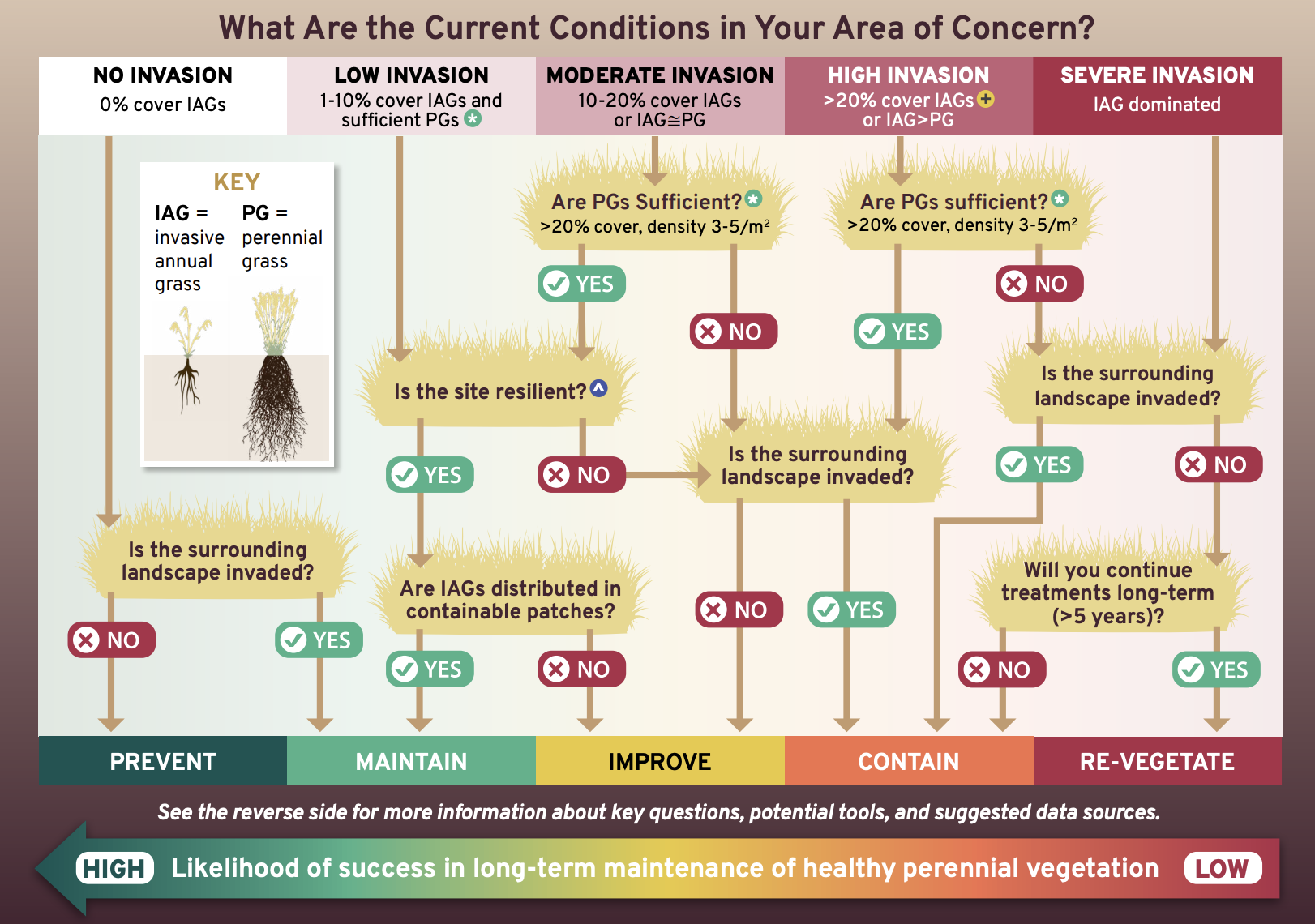
ODA, in partnership with Oregon State University and The Nature Conservancy, developed this Decision Tree to empower rangeland managers across the whole spectrum of interventions, from invasive annual grass prevention and maintenance of functioning areas to improving condition through restoration, containing problem areas, and intensive revegetation. This guide provides a decision support tool with generalized, science-based information on the first page, and then identifies potential management strategies, key questions, potential tools, and suggested information sources on the second page.
This table provides generalized guidance on activities, key questions, and tools for each management strategy as identified on the previous page. This tool was developed in the semi-arid rangelands of eastern Oregon and is most applicable in the northern Great Basin. If noxious weeds or weedy forbs (e.g. rush skeletonweed, spotted knapweed, Russian thistle, redstem storksbill, salsify etc.) are present in your vegetation community, plan accordingly, as plants like these can be ‘released’ by herbicides that target IAGs. Consultation with weed experts or properly licensed applicators is recommended in all cases. Follow herbicide label recommendations: The label is the law
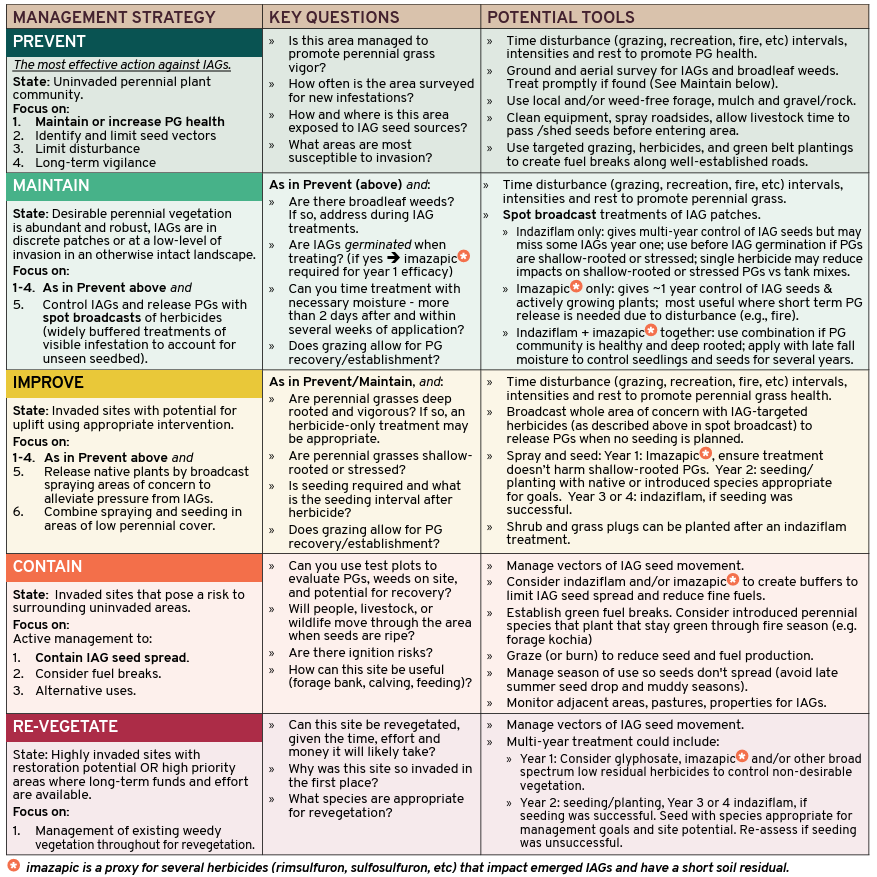
Decision Tree for Managing Rangeland Health Against Invasive Annual Grasses

CONTACT INFORMATION
Mark Porter, Oregon Department of Agriculture - Rangeland Health Specialist, Noxious Weed Department mark.porter@oda.oregon.gov
Toby Maxwell, Oregon State University, Cascades, Assistant Professor: Senior Research toby.maxwell@osucascades.edu
Megan Creutzburg, The Nature Conservancy, Sagebrush Sea Upland Restoration Program Manager megan.creutzburg@tnc.org
Oregon Department of Agriculture https://www.oregon.gov/oda
Stay tuned for a webinar!
We are losing an average of 1.3 M acres of functional rangelands each year in the sagebrush biome, largely driven by invasive annual grasses (IAGs). This document intends to empower rangeland managers and practitioners to explore treatment options by providing a broad overview of management strategies where rangelands are vulnerable to IAGs. The decision tree below walks through key questions with generalized, science-based information where available (e.g., % cover thresholds) to inform decisions, leading to management strategies with potential actions.
Consult local weed experts when using this document.




IAGs are widespread and entrenched in many western rangelands; approach management with long-term goals and an adaptive mindset. Ongoing vigilance, monitoring, and management will be necessary for durable outcomes.
Work with neighbors to expand areas of good condition and make IAG control more effective.
Manage site to promote perennial grass (PG) health and vigor - healthy perennial vegetation helps keep IAGs out.
Prevention and early intervention are the most effective options for IAG management. Where intensive restoration is needed, be patient, learn from past treatments, and try treating test plots to evaluate potential outcomes.
In a post-fire environment, consider soil stability, burn severity and perennial grass recovery.

Spatial Tools for IAG Assessment
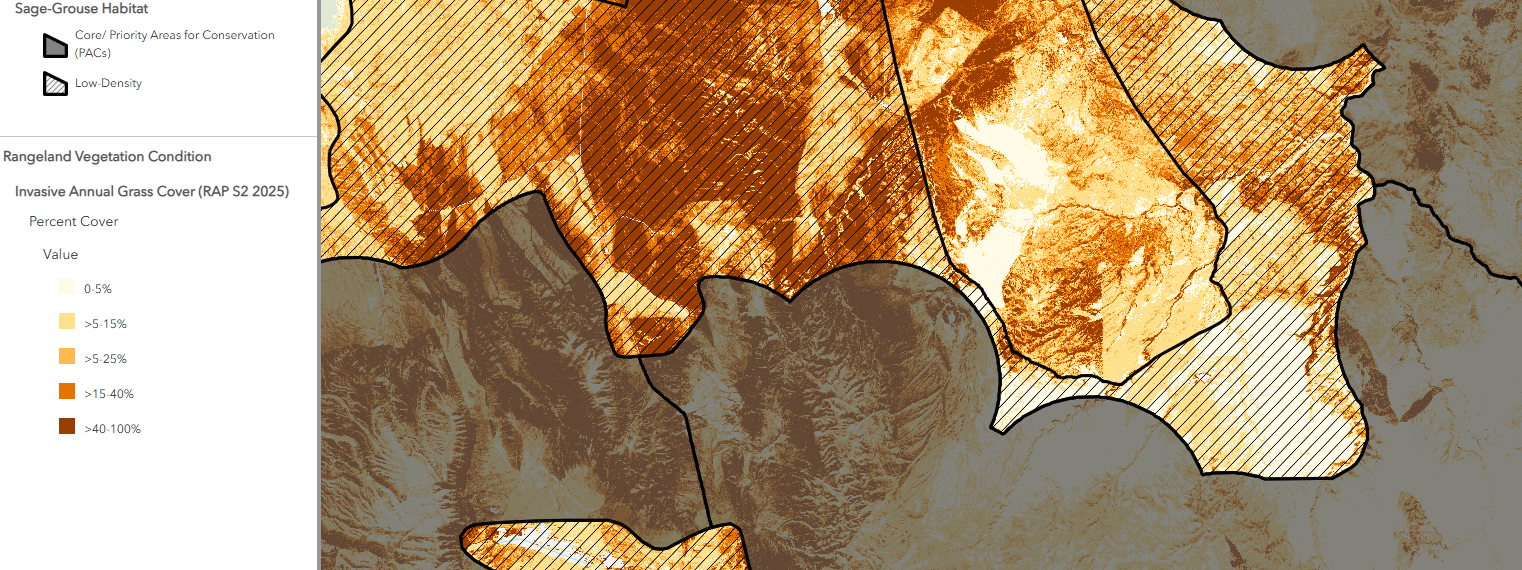
There are many geospatial tools that can help visualize and quantify landscape context and the degree of invasion across large landscapes, including:
• The SageCon Landscape Planning Tool contains threat-based ecostate maps across the sagebrush biome and many other datasets in eastern Oregon, including elevation-heatload index, BLM monitoring plots and others.
• The Sagebrush Conservation Design web viewer includes many regional data layers.
• The Rangeland Analysis Platform produces maps and graphs of rangeland plant functional group cover over time through an easy-to-use web interface.
• New Invasion Severity Index maps show IAG cover relative to cover of perennials and bare ground to help us estimate to what degree IAGs are altering the plant community.
A practical synthesis of Invasive Annual Grass Management
At the 2025 SageCon Partnership Annual Summit, a rangeland restoration panel delivered practical information on restoration and post-fire rehabilitation, with a focus on strategic management of invasive annual grasses. This synthesis draws out key information from the panel and organizes it by theme.
Other IAG resources
For more information about IAGs in the sagebrush, see the resource list below as a starting place.
The University of Wyoming’s Institute for Managing Invasive Grasses Invading Natural Ecosystems (IMAGINE) website contains a wealth of easily digestible and up-to-date information on IAG management. Highlights include: